Thanks for putting this together. Since your summary covers the broader scope of “Astar’s Financial Hub,” it makes sense to keep this thread more focused on dApp Staking (which is why I suggested splitting the discussion into separate threads).
As a baseline, dApp Staking currently accounts for the following portions of ASTR inflation:
- dApp Rewards: max 13%
- Base Staker Rewards: 10%
- Adjustable Staker Rewards: max 55%
- Bonus Staker Rewards: 13.8%
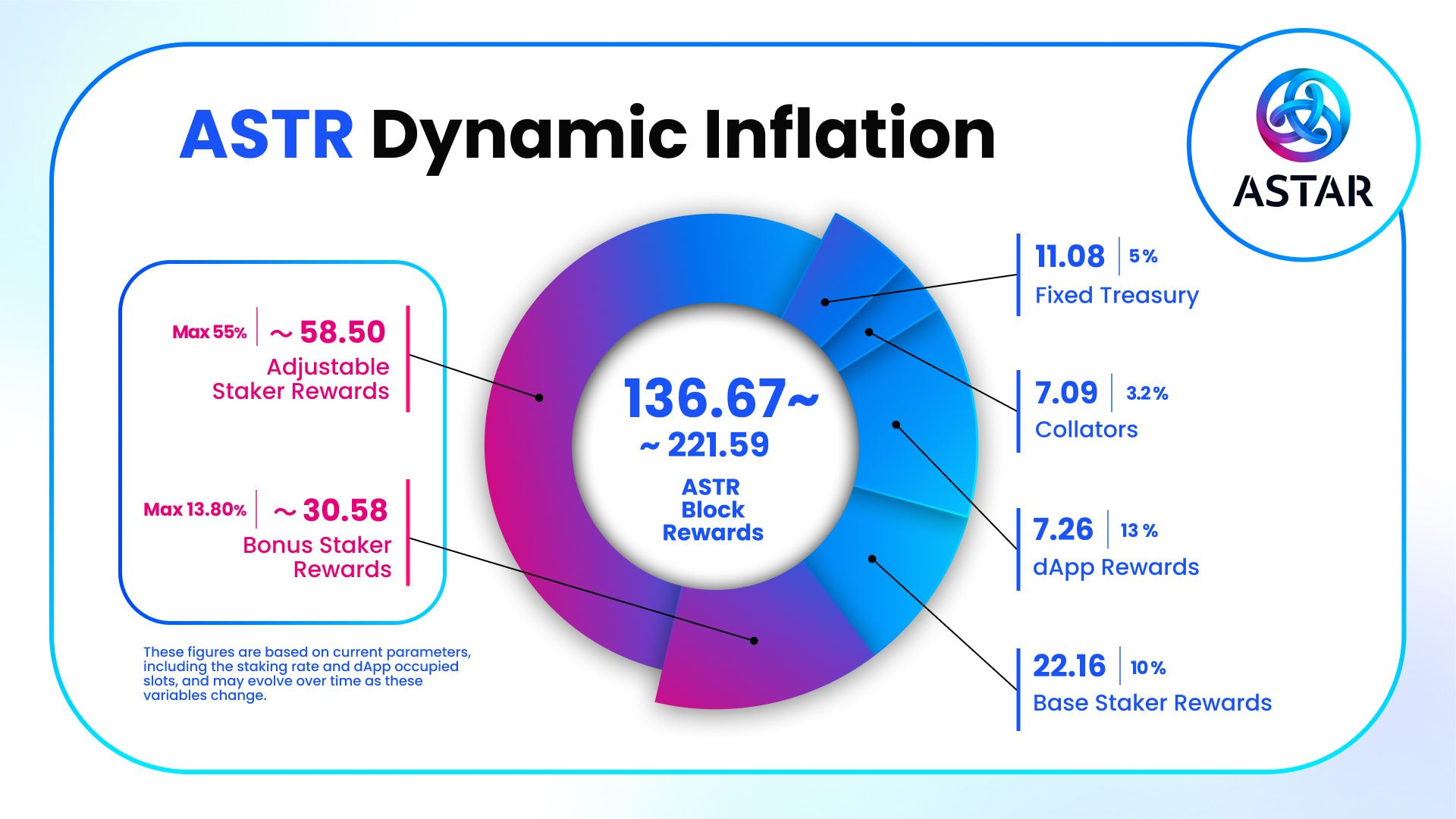
At the moment, the discussion is largely centered on developer rewards, but this is not a particularly large share of total inflation. The 13% figure assumes that all tier slots are filled; in reality, only 29 out of 60 slots are currently being used:
- Tier 1: 2/3
- Tier 2: 3/12
- Tier 3: 10/18
- Tier 4: 14/27

Because reward scaling by “level within a tier” makes the calculation more complex, I excluded levels and did a simplified estimate. Under that assumption, the actual emissions appear to be roughly ~50% of the 13% allocation, i.e., around 6–7%. Also, since Tier 1— which accounts for a large share—includes Astar Core Contributors and the Community Treasury, it is less likely to translate directly into sell pressure (at least the Community Treasury would not sell this directly).
In other words, if the concern is that “inflation from dApp Staking is diluting ASTR’s value,” then discussing only developer rewards is not sufficient.
In practice, staker rewards make up 78.8% of inflation at maximum—this assumes the dApp Staking staking ratio reaches 50%. The actual staking ratio is around 18.7%, so Adjustable Staker Rewards would be roughly ~17%. Recalculating based on actual emissions (again, roughly), developer rewards are about ~10% of inflation, while staker rewards are about ~60%.

These are rough numbers and not perfectly precise, but they should capture the overall inflation picture. And as the numbers show, focusing only on the developer side has limited impact—we need to think about more fundamental solutions.