Hello, Astar Community!
We’re excited to share an important evolution in how Astar Network manages its collator infrastructure. As part of the Runtime-1900 upgrade, Astar has transitioned from a permissionless collator registration system to a governance-approved collator selection process.
This change represents a significant milestone in Astar’s journey toward a governance-led ecosystem, placing collator management directly under the oversight of our governance system. By requiring governance approval for all new collators, we ensure that only vetted, committed, and qualified node operators participate in block production, strengthening network security and operational standards across the ecosystem.
I. Understanding Collators in the Astar Ecosystem 
Before diving into the new system, let’s understand what collators do and why they matter.
What Is a Collator?
A collator is responsible for producing blocks and confirming transactions on Astar Network. Think of collators as the network’s block producers: they collect transactions from users, package them into blocks, and produce state transition proofs for Polkadot’s Relay Chain validators to verify.
Why Quality Matters
The primary focus for Astar’s collator infrastructure is ensuring high operational standards and accountability. The main risk collators pose is transaction censorship, but this is mitigated by ensuring a diverse set of honest collators. Theoretically, even a single honest collator prevents complete censorship. This is why Astar focuses on vetting collators for quality, commitment, and operational standards, ensuring that each collator meets the network’s requirements for security and performance.
 Learn More About Collators in Our Documentation
II. Why the Change to Governance-Approved Selection? 
The previous permissionless system allowed anyone meeting the bond requirement to register as a collator candidate. While this approach maximized openness, it lacked mechanisms to ensure operational quality and accountability.
The new governance-approved system addresses these limitations by introducing community oversight at every stage. Prospective collators must now demonstrate their commitment and receive explicit approval from Astar Governance before joining the active collator set. This ensures:
- Enhanced Network Security: Only vetted operators with proven track records can participate in block production
- Higher Operational Standards: Governance can verify technical capabilities and infrastructure quality before approval
- Community Empowerment: ASTR holders and governance bodies have direct say in who secures the network
- Improved Performance Monitoring: Governance retains authority to remove underperforming collators
- Quality Control: Focus on maintaining a professional, accountable collator set
What Remains Unchanged
It’s important to note that all collator-related parameters remain the same: bond amounts, slashing percentages, reward structures, and the collator set size are unaffected by this upgrade. The change is purely about how collators join and leave the network.
III. The New Collator Application Process 
Under the updated system, becoming an Astar collator follows a structured two-step process designed to ensure transparency and community oversight.
Step 1: Submit Your Application
Forum Post Requirement: Prospective collators must first submit a public application post on Astar Forum. Your application should include:
- Introduction and background of your organization or individual operation
- Technical infrastructure details (hardware specifications, data center country, redundancy measures)
- Operational experience (previous blockchain node operation, uptime records)
- Commitment statement explaining your motivation to support Astar Network
- Your node’s public address and contact information
The forum post must remain open for a minimum of 7 days, during which the community will evaluate your request and initiate a collective dialogue with the proposer.
Step 2: Governance Approval
Once your forum application is submitted and you have received positive feedback from the community, you proceed to the governance review process:
- Bond Reservation: After gathering community feedback on your forum post and confirming interest in proceeding, you must call the
apply_for_candidacyextrinsic onchain, reserving the required 3.2M ASTR bond. This bond demonstrates your financial commitment and remains locked throughout your tenure as a collator.
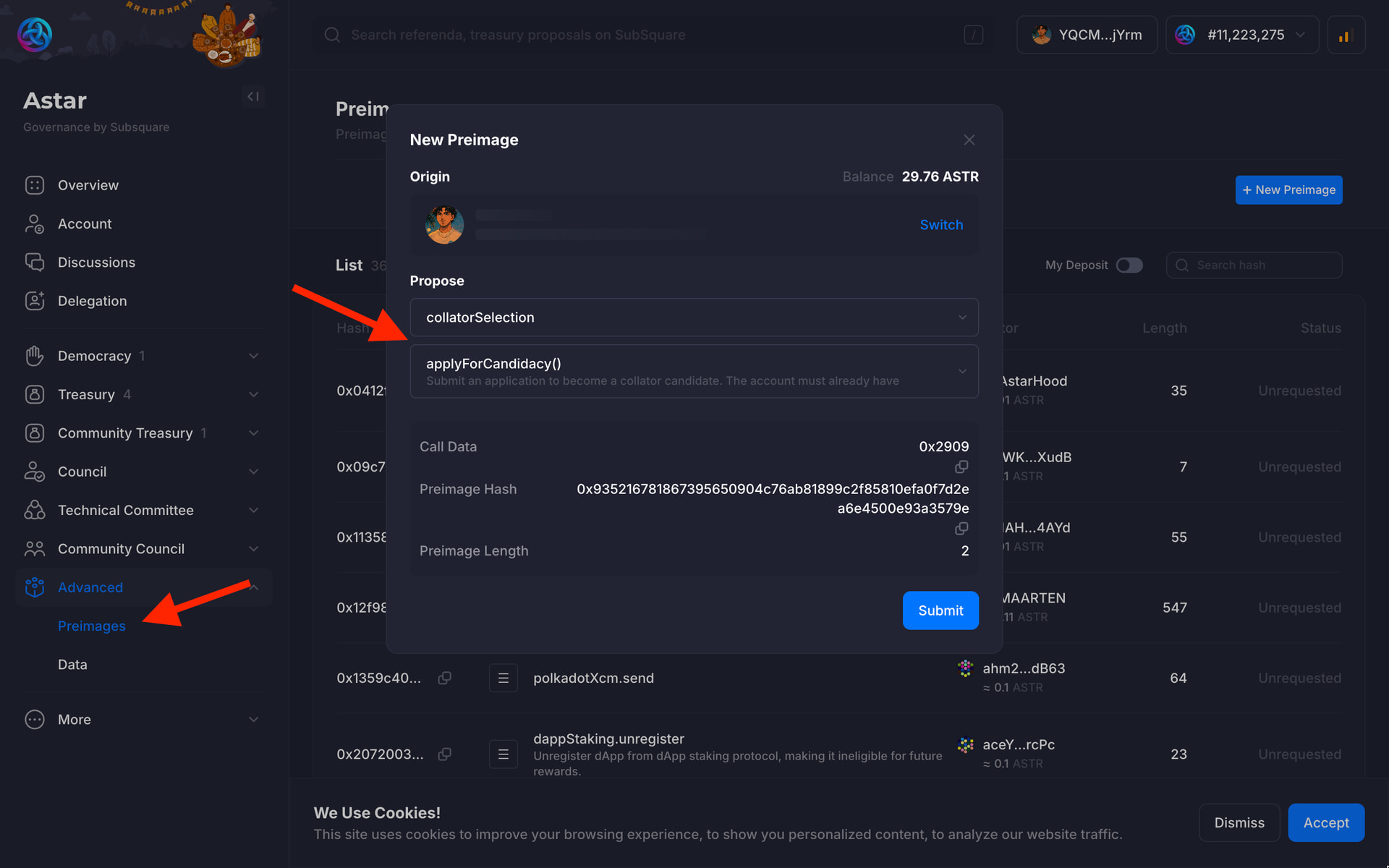
- Approval Paths: Your application can be approved through two mechanisms:
- Public Referendum: Allowing all ASTR holders to participate in the decision. This is the primary path for collator approval, ensuring maximum community involvement in determining who secures the network.
- Main Council Approval: Alternatively, your application can be approved by a two-thirds majority vote from the Main Council. Council members review your application, assess your qualifications, and vote on whether to add you to the collator candidates pool.
Upon Approval: Once governance approves your application via the approve_application extrinsic, your node is officially added to the collator candidates pool and can begin participating in block production.
Review Here How to Submit a Public Referendum
Withdrawing Your Application
Changed your mind? The close_application extrinsic allows applicants to withdraw pending applications and unreserve their bond before governance approval. This flexibility ensures applicants aren’t locked into commitments if circumstances change.
IV. Governance Actions: Oversight and Enforcement 
The new system empowers Astar Governance with formal mechanisms to maintain network health and enforce operational standards.
Governance Origins
The collator selection pallet utilizes two distinct configurable origins:
- GovernanceOrigin: Responsible for approving and closing candidacy applications. On Astar, this requires either a two-thirds majority vote from the Main Council or approval through a public referendum.
- ForceRemovalOrigin: Handles the forcible removal and slashing of candidates. The configuration mirrors GovernanceOrigin, requiring either three-fourth Main Council approval or referendum passage.
Removing Underperforming Collators
Governance has multiple mechanisms to remove collators depending on the situation and severity:
- Immediate Removal with Slashing (
kick_candidate): For active collator candidates requiring immediate action due to poor performance or malicious behavior, governance can remove them instantly and slash 1% of their bond. This call can only be executed by theForceRemovalOrigin. - Removal Without Slashing (
leave_intentviadispatch_as): In situations where governance wishes to remove a collator without financial penalty (e.g., voluntary departure assistance, special circumstances), this can be achieved by wrapping theleave_intentcall with the utility pallet’sdispatch_asfunction through a referendum. The removal takes effect in the next session. - Removing Invulnerables (
remove_invulnerable): For invulnerable collators, removal requires a public referendum. This ensures maximum community oversight for changes to the network’s core infrastructure operators.
V. Important Notice for Existing Collators 
If you’re already operating as an Astar collator, here’s what you need to know:
- Existing collators remain active: Current collators are not affected by this upgrade. Your position in the collator set is maintained, and no additional action is required to continue operations.
- Deprecated Extrinsic: The previous
register_as_candidateextrinsic has been deprecated and will return a Permission error if called. All new collator candidacy submissions must utilize theapply_for_candidacyextrinsic followed by governance approval. - Governance Oversight Applies: While existing collators don’t need to reapply, you are now subject to governance oversight. The Main Council and community have formal authority to remove collators who fail to meet standards through the mechanisms described above.
VI. Technical Reference 
For developers and technical operators, here’s a summary of the new extrinsic calls:
| Extrinsic | Purpose | Origin |
|---|---|---|
apply_for_candidacy |
Submit application, reserve bond | Any account with 3.2M ASTR |
close_application |
Withdraw pending application, unreserve bond | Applicant |
approve_application |
Approve candidacy, add to collator pool | GovernanceOrigin (Main Council 2/3 majority or Public Referendum) |
kick_candidate |
Remove active collator candidate from the set and slash 1% of bond | ForceRemovalOrigin (Main Council 3/4 majority or Public Referendum) |
remove_invulnerable |
Remove an invulnerable collator from the set | Public Referendum |
GitHub PR with Full Technical Details
VII. Closing Thoughts
The transition to governance-approved collator selection represents Astar’s continued commitment to community oversight and operational excellence. By placing collator management under governance control, we ensure that the network’s block producers are accountable to the community they serve and meet the high standards required to secure Astar Network.
Thank you for your continued support in building the Astar Collective. Together, we are shaping a future where governance, contribution, and ownership are inseparable. 
 .
.