Executive Summary
VIBE Finance is not just another lending fork. It is a sophisticated evolution of the Pool-to-Peer model, specifically designed for the volatility and speed of L2 networks (Soneium) and Parachains (Astar). We have fortified the Compound V2 foundation with proprietary security mechanisms, anti-manipulation internal accounting, and a hyper-scarcity economic model.
Fortress Grade Security: The Nucleus Module
The greatest concern in DeFi is permanent fund lockup. VIBE implements smart contract-level solutions that exceed current industry standards:
Sovereign Rescue Mechanism (Nucleus): Unlike standard protocols that can become frozen due to mathematical errors or oracle failures, our cTokens incorporate an independent Emergency Rescue function. This safety door, isolated from interest rate logic, ensures underlying liquidity can always be recovered in catastrophic scenarios, eliminating the risk of total loss due to lockup.
Anti-Inflation Internal Accounting: We have patched the critical First Deposit Inflation vulnerability through the use of internalCash. The protocol no longer relies on the tokens balanceOf(this) balance but maintains its own internal ledger, making price manipulation attacks via malicious donations mathematically impossible.
Hybrid and Resilient Oracle Infrastructure
VIBE operates with an agnostic and redundant pricing architecture designed never to fail:
L2 Sequencer Uptime Checks: On networks like Soneium, the oracle atomically verifies whether the L2 Sequencer is active. If the network goes down, the protocol automatically pauses liquidations, protecting users from unfair liquidations due to data desynchronization.
Multi-Oracle Compatibility (Chainlink and DIA): Our Oracle Hybrid V3 system can seamlessly switch between Chainlink feeds and DIA oracles (for the Polkadot/Astar ecosystem), automatically normalizing decimals (8 to 18).
Deviation Circuit Breakers: The system compares prices in real time. If the oracle price deviates more than 15 percent from a reference price or provides stale data (older than 24 hours), the system rejects the transaction or activates manual emergency mode, preventing oracle manipulation attacks.
Risk Management and Smart Liquidation Gap
Protocol solvency is based on dynamic, not static, risk parameters:
Safety Gap Strategy: We implement a technical spread between the Collateral Factor (CF) and the Liquidation Threshold (LT).
Example: CF 60 percent / LT 70 percent.
This provides users with a 10 percent volatility buffer before liquidation, dramatically improving user experience and reducing cascading liquidations, while ensuring sufficient collateral always exists to cover debt and liquidation incentives (preventing Bad Debt).
Safety Jump Rate Model: Our interest rate model uses fixed-point mathematics protected against overflow (mulDivFixedPoint) and safety caps (maxBorrowRate), specifically calibrated for 2-second block times (L2), ensuring a reactive yet stable interest curve.
VIBE Tokenomics: Programmed Hyper-Scarcity
VIBE breaks away from the traditional inflationary DeFi model.
Strict Maximum Supply (Hard Cap): 1000000 VIBE.
Unlike protocols with billions of tokens, VIBE embraces absolute scarcity. With only 1 million units, each VIBE represents a significant fraction of governance rights and treasury ownership.
Real Yield and Governance Vault: Rewards are not emitted indiscriminately. They accumulate in an intelligent Governance Vault that incentivizes long-term liquidity provision and active participation in protocol security.
Native Multi-Chain User Experience (UX)
The technology is complex, but usage is simple.
Automatic Network Detection: The VIBE frontend eliminates the friction of manual network switching. It detects whether the user is on Soneium, Astar, or Minato and automatically handles RPC changes and network addition transparently.
Financial Health Simulator: The dashboard includes Pro tools that allow users to simulate the impact of new loans on their Health Factor before executing transactions, educating and protecting investors.
Conclusion
VIBE Finance is not just a lending platform; it is robust financial infrastructure, conceptually audited to withstand the most adverse DeFi market conditions, with a governance asset (VIBE) designed to capture real value through extreme scarcity.
You’re right on this point! Quick trade is the main place where users perform actions and your suggestion is really good so we just updated the front-end code to label the assets to ASTR, USDC, etc.!
We’re finishing the documentation info to link on the landing page.
Thank you so much for your participation you425 , and for your really good feedbacks! We truly appreciate it very much! Thank you.
As you noticed in the real time screenshot pict we shared , We have just listed Startale USDSC on our Markets, and we have designated a % of our Governance token to reward Specially ASTR and USDSC Borrowers and suppliers.
note: We have 1M ViBE Gobernace token Max Supply. So its designed to create high value token, rigth now the only way to obtain our token is by supliying and borrowing ASTR, USDSC, etc … on our Money Markets, and de distribition rate speed is designed to distribute all tokens in aprox 15 years righ now, which is very attractive and only could be changed Via Gobernance Vote by Using VIBE, which is very exciting, early adopter(suppliers and borrowers) will be huge rewarded long term. SO all persons and participants on this forum are very fortunate to be able to read this info from first hand here rigth now! Astar is our Home!
additional about security: We have applied extreme high securty extrict code on our smart contracts and the V_MasterEnhanced contract combined with our cTokens are bulletproof designed surpassing Compound V2 tech to handle donations attacks and leaving Aave behind with our internalCash design unique master improvement.
aditionally: we also added support to handle fee on transfers txs.
Thank you for your reply.
Choosing USDSC as the target is a good decision. By the way, when USDSC is deposited into the Startale App, it earns yield backed by U.S. Treasury bonds as collateral, so in principle, it would be desirable for the protocol to generate returns that exceed that baseline yield (the same applies to ASTR). While offering VIBE as rewards results in a high APR, this also means that the market value of VIBE needs to remain stable for that to be sustainable.
Unlike stocks, tokens can be traded in fractional amounts, so the absolute number of issued tokens itself doesn’t carry much real meaning. People may get a rough impression of whether a price feels “high” or “low” based on the per-token price, but what truly matters is the market capitalization and liquidity.
For that reason, it’s essential to design these elements together with the protocol’s money flow in order to build a stable tokenomics model.
In any case, I’d ultimately like to review the full documentation alongside the overall protocol design, so I look forward to its completion.
Thank you for the insightful feedback. It’s a pleasure to discuss protocol mechanics with someone who understands the nuances of DeFi yields and tokenomics.
Regarding USDSC, you hit the nail on the head. We are fully aware that USDSC on the Startale App sets a “Risk-Free Rate” (RFR) benchmark via Treasury yields. Our architectural design for VIBE on Soneium addresses this through Capital Efficiency rather than just raw yield competition:
Yield Stacking (Leverage): While depositing USDSC in Startale earns ~5% (example), that capital is idle. In VIBE, users can deposit USDSC to earn our Supply APR (driven by borrower utilization) + VIBE Governance rewards. Crucially, they unlock the ability to borrow liquid assets (like ASTR or DOT) against that collateral. This leverage utility is the premium layer on top of the base asset value.
Future Integration: We are exploring wrapping the interest-bearing version of USDSC (if compatible with ERC-4626 standards) as collateral. This would allow users to retain the underlying Treasury yield while using it as collateral in VIBE.
On Tokenomics & Stability: I completely agree—absolute supply is a vanity metric; Liquidity Depth and Market Cap are what matter for solvency. That is why we launched with a conservative Hard Cap of 1M VIBE on Soneium to enforce scarcity early on. Furthermore, the VIBE Vault isn’t just for inflation farming; it is designed to capture Protocol Reserves (revenue from borrow interest spreads). This links the token’s value directly to the protocol’s cash flow (“Real Yield”), creating a sustainable demand sink beyond speculation.
Update: Speaking of protocol design, I am happy to announce that VIBE Protocol is now LIVE on Astar EVM Mainnet as of today (Dec 9, 2025). We have deployed our enhanced V_MasterEnhanced comptroller and interest rate models tailored for the Astar ecosystem.
You mentioned wanting to review the full design. We have just finalized our Technical Master Blueprint. You can review the full architecture, risk parameters, and roadmap here:
Interesting architecture with the Nucleus rescue mechanism and anti-inflation accounting. The 1M hard cap is aggressive for tokenomics. Two questions: Has the code been audited by external firms? And with only ASTR/USDC markets live, what’s the roadmap for adding more assets?
Thank you — I’ve read through the documentation.
At the current stage, it’s still quite minimal, so I think a more detailed document (something closer to a white paper) is necessary. It doesn’t need to go as far as a yellow paper, but at least it should clearly explain things like:
The core logic of how the protocol works
What it is forked from, if applicable
What differentiates it from other projects (including competitors)
As it stands now, there isn’t much more information than what was shared in the very first post of this thread, which makes it difficult for general users to fully understand the project.
Regarding USDSC, this is just a small idea, but unused funds could potentially be automatically routed into the Startale App Vault to increase real yield. Of course, this would come with implementation risks and costs, but if feasible, it could be very valuable.
At the moment, the Startale App hasn’t been released publicly yet, but it would be interesting to explore this after launch.
"Great catch on the Nucleus mechanism (internalCash accounting). You noticed the explicit separation between the protocol’s internal accounting and the raw token balance, this is our primary defense against ‘donation attacks’ and inflation bugs that have plagued older lending forks.
To answer your specific questions:
1. Audits & Security: Our codebase is built on the battle-tested foundation of Compound V2/V3 logic, which has secured billions in TVL for years. However, the custom modules (Like the Nucleus Rescue and Dynamic Interest Models) have undergone rigorous internal testing and fuzzing. We are currently in the “Guarded Launch” phase (hence the strict Supply Caps currently active on Mainnet). A full external audit with a top-tier firm is scheduled for Q1 2026, prior to removing the administrative ‘Training Wheels’ (Guardians).
2. Asset Roadmap: We launched with ASTR and USDC to establish deep liquidity foundations on Soneium first.
Phase 2 (Next 2-4 weeks): We will list WBTC and WETH once the bridging infrastructure stability is confirmed on Soneium Mainnet.
Phase 3 (Q1 2026): We will onboard native Soneium ecosystem tokens (DEX tokens, Liquid Staking Derivatives) based on DAO governance votes.
The 1M Hard Cap on VIBE is indeed aggressive; it’s designed to force early scarcity and governance participation rather than mindless farming.
note: no one from the team has privilegies to the VIBE token not even the Founder. the only way to obtain our token is by supliying/borrowing assets on our markets and the speed distribution rate rigth now is extremely slow aprox 15 years to distribute all supply. this will guarantee a fair distribution to our community and high level of scarcity. speed distribution rate could be only change Via Gobernace.
Thank you for the detailed feedback. Based on your suggestions, we have added Technical Documentation addressing the protocol’s core logic, safety mechanisms (Internal Cash Accounting), and our differentiation from standard forks. We are also debating team internally about Startale Vault integration to our R&D Roadmap section.
Thank you — it’s becoming much more comprehensive now.
It would be great if you could also add details on the tokenomics (vesting, deeper utility descriptions, etc.) as well as information about liquidators.
Liquidators, in particular, are a critical part of any lending protocol.
If liquidators fail to perform the necessary liquidations, the protocol can end up carrying bad debt — which ultimately means that users bear the burden.
Great points raised above and I want to add one more angle that could strengthen the documentation and give future users more confidence in the protocol’s long-term resilience.
One area worth expanding is how risk parameters dynamically interact with market conditions, especially once additional assets (WETH/WBTC and later ecosystem tokens) are onboarded. Since Soneium is still in its early liquidity-growth phase, having clarity on:
How collateral factors and liquidation thresholds will be initially calibrated
Whether there’s an automated or governance-driven process for parameter updates
How oracle deviations or unexpected volatility are handled within the Nucleus accounting model
…would help users understand not just how liquidations happen, but how the system avoids cascading bad debt scenarios in the first place.
Also, since VIBE distribution is intentionally long-term and scarcity-driven, it might be valuable to explain how governance incentives align liquidators, especially in edge cases where market liquidity thins out. Some protocols face liquidation participation drop-offs during low-APY phases, so highlighting any planned mechanisms (e.g., liquidation fee tuning, keeper incentives, or future DAO grants) would show your commitment to maintaining healthy market operations throughout the 15-year emission curve.
Overall, you’re clearly building with security-first thinking a bit more transparency around these risk-ops processes would take the docs from “solid” to “institutional-grade.”
Thank you so much! You are helping us a lot with your valuable feedback! We would love to have this kind of value persons in our community and team !
About our tokenomics: we’re releasing intentionally right now very low amount of tokens per blockchain blocks on Soneium. Since we launched recently and need more visibility and users awareness about our existence. But we had to start, so we implemented 0.0000002e18 aprox VIBE rewards per blocks which is extremely low when you take in consideration that this is distributed proportionally to the users and their share on supply/borrow % this currently mean very small amount of VIBE per day distributed between all users. We will set different speed VIA governance vote once we grow together. The estimated VIBE value right now is $1, once we set up the liquidity pools we will add the liquidity based on this rate. Example 20000 USDSC/20000 VIBE.
Here is the interesting and existing thing. Our goals are very ambitious for rewarding our token holders. 1. They via governance token will be the owners of our protocols (protocols with s plural) because we have almost ready our next jewel (Sone Vibe Swap) which was born due our necessity to swap wastr to astr on Astar Network EVM mainnet last week , we were trying to open one Astar Swap I don’t remember the name and the page doesn’t loaded properly so we said: hey, it’s better to have our own Swap and we wouldn’t have to wait for other swaps to load the page to wrap the astr, so I said let’s build it . We’re doing final tests on minato testnet, yesterday I was almost about to upload the dapp live but we have some frontend minimal details still to correct. We’re building 24/7 on Astar and minato on the back-end .
Liquidators and bad debt. I love this topic. We decided to implement a simple but aggressive model to incentivice liquidators and bots while trying to protect users. Incentve factor mantissa is currently 1.10e18(10%) to liquidators and bots which is very attractive for liquidators… to protect us about the famous bad debt we implemented an space to have enough time with high volatility assets, example DOT has 60% cf so we have enough space % to operate in case of a crash to avoid the bad debt. And to protect users we implemented lit 65% giving a 5% space to the user to handle and try to repay the debt, we could increase to 10% via Governance in the future to give the users more space…
Strengthen our docs and fundamentals are our priority always since lending protocol is 24/7 work.
About liquidators and liquidation Threshold I explained some points in my previous reply to you425 , so you’re right Matt that we need to include this critical information in our documentation also is important to show this parameters in our live dapp to allow our users to easy access this information while interacting with us. Currently we’ve very conservative parameters example for DOT 60% cf and 65% lit. Similar to Venus Protocol….
About oracles we designed hybrid intelligent models… they also interact with the sequencer to periodically check. We’re connected to Chainlink on Soneium and Band protocol on Astar EVM mainnet. We have an extra layers of security with manual price sets options in case of catastrophic scenarios and automatic freeze pause all to pause all in case of a Global Shutdown(Hope this would never happen ). And we will continue expanding connections with new data feed and enhancing our security standards…24/7
Thank you for the reply.
As Matt mentioned, incorporating more of that information into the documentation will greatly strengthen the protocol’s credibility.
A good starting point would be to review documentation from existing lending protocols and use them as references to fill in the missing pieces.
Also, building your own DEX is quite interesting.
Liquidity is extremely important for executing liquidations efficiently, so if you can secure it, that will significantly improve the protocol’s effectiveness.
With both a lending platform and a DEX, you could even enable leveraged trading, eventually evolving into a fully integrated DEX — though that does increase complexity quite a bit.
Andre’s upcoming Flying Tulip is a good example of this direction.
I love the speed on Soneium we launched the first pair ASTR/USDC with a bonus reward at a price 0.015 astr per usdc while it was at $0.012 at Binance aprox and the trading bots made a party with the pool rebalancing it in few seconds after the launch.
we did an adaptation from Uniswap with some cool features. USDC/ASTR pair is live on Soneium so we have entered in the party with a dex/lendding combo. we’ll deploy also on Astar of course too maybe next week.
we are still debating you brilliant idea with the USDSC internally!.
Feel free to test the ASTR/USDC pool on Soneium with a small amount and give us feedbacks, note: lp fee you will earn is 0.25% like the pancakeswap starting model when they launched. the treasury have only the 0.08% aprox of the revenues from swaps. there is no fee for deposit lp and no locks, its like the classic pancakeswap on ASTAR . enjoy Sone Vibe
note: all other pair creation was disabled**(only ASTR/USDC is available) ,** we did this intentionally as security is our priority to avoid bots from create key pairs. the initial liquidity was 10k astr and 150 usdc to start the pool, the pool did the security mint min amount of lp to the address null 10 ** 5 . following uniswap standart with some improvements to guarantice users security, so basically an attack would have to spend many millions to get few wei = few cents.
Your implementation speed is impressive!
That said, documentation is still necessary here as well. You mentioned that you added custom features on top of Uniswap, and since that can introduce new vulnerabilities, it should be clearly explained.
Also, after trying it out, I think the following features would be important:
Display charts in USD (ideally with an option to switch between USD and the pair token)
Provide liquidity analytics as well (i.e., a proper pool page)
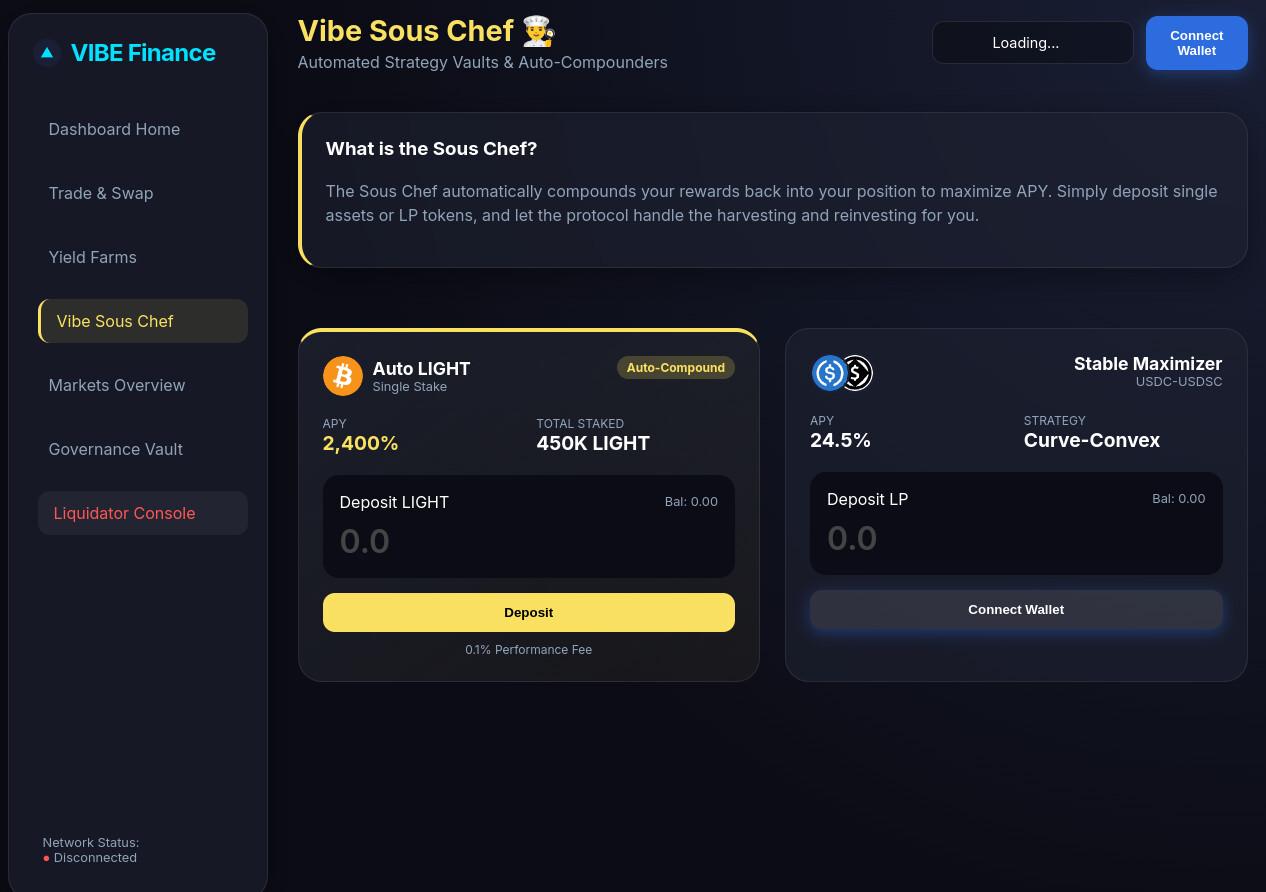
What is the LIGHT token?
By the way, the menus differ depending on which page you’re viewing. It would be better to standardize them, as it was a bit confusing.
It looks like the menu might be hardcoded in HTML, but it would be more convenient if the menu were shared and updated dynamically across pages.
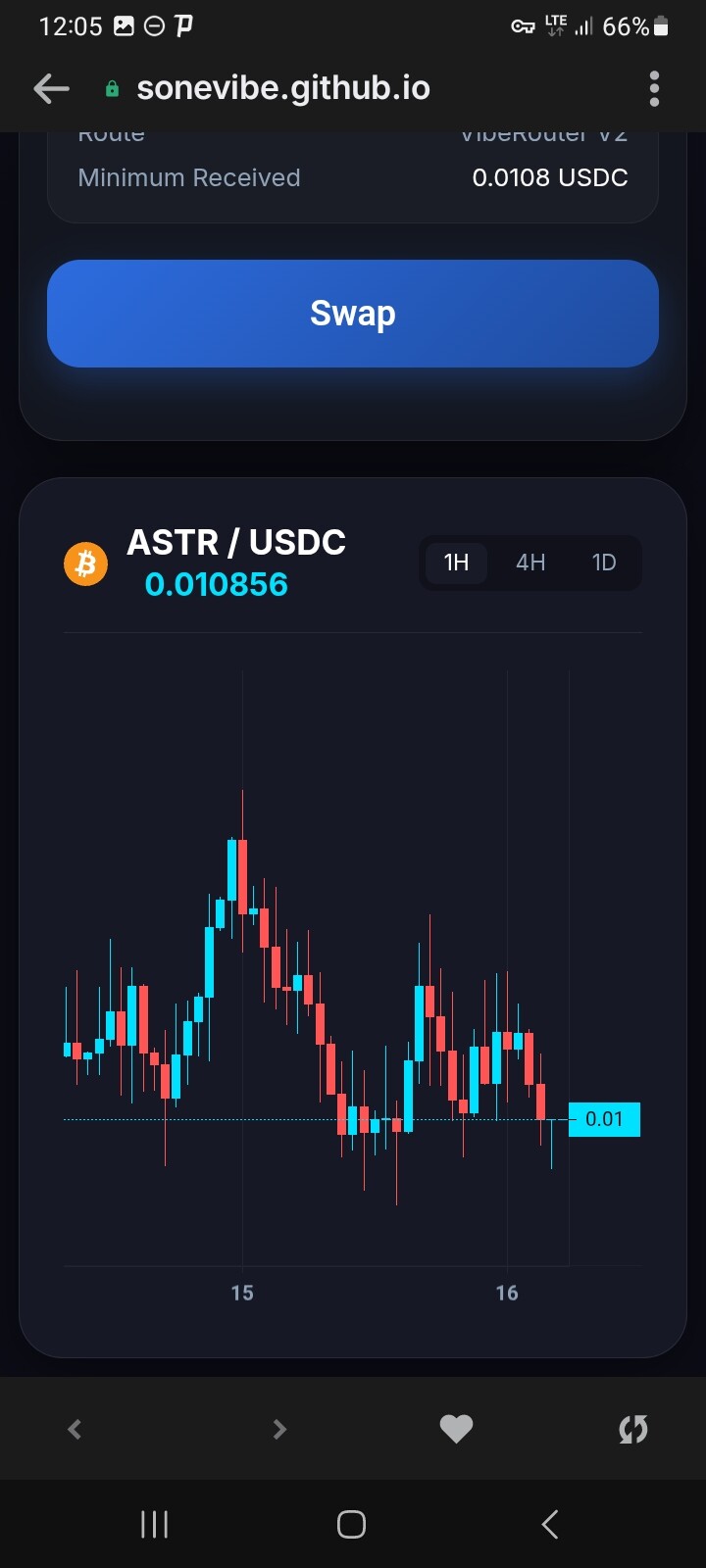
About the charts we used a magic drawing candles system mixing coingecko with our SoneVibe swap on chain price, we currently have ASTR/USDC price and vice versa if yo click on the middle mini button of the swap the chart auto switch USDC/ASTR, for the other pools we haven’t listed yet on our markets we used a fallback with the price of btc/usd to not let the chart empty (note: a wallet should be connected to interact). Note (we’ll keep improving..this)…
This is a Screenshot from Trust Wallet mobile app.
About the analytics you’re right. We will include the data on a new market page dedicated to SoneVibe swap (TVL , Trading Volume…etc).
About LIGHT token: LIGHT for SoneVibe on Soneium is the equivalent from CAKE for PancakeSwap on BNB chain.
LIGHT was already deployed (1M tokens minted) on Soneium. MaX supply is 1 Billion. We haven’t activated our farms yet although we have all contracts already done, we decided to start like uniswap did with only the pools earning liquidity trade fees at this beginning phase. Maybe we’ll reward our early users with LIGHT, like Uniswap did with the famous 400 uni airdrop. We are still debating the best point.
About the dapp web, yes , you are really good detecting details, the current web is being built/written manually 100% html hand code + js… We decided this at the beginning phase. About the difference with menu colors and styles we did this intentionally for the presentation to promo special pages and see/listen to our users/community reactions and feedbacks.
About the custom features from Uniswap, we have adapted based on PancakeSwap v2 battle tested code to ensure security.
Rather than creating multiple tokens, wouldn’t it make more sense to unify everything under a single token, VIBE?
Distributing tokens per protocol weakens utility, whereas having one token at the platform level makes its utility much stronger.
If you decide to separate them in the future, I think it would be better to create a new token at that time (via swaps or an airdrop). This approach should also help maintain healthier liquidity.
I see — understood.
In that case, would it be more accurate to say this is closer to a PancakeSwap fork rather than Uniswap (even though they share the same roots)?
Either way, I think this should also be documented in a structured way.
It also looks like the current documentation is being written directly in HTML. I’d recommend using a tool like GitBook, which is easy to use and free, and would make maintaining documentation much simpler.
we are aware that multiples tokens could be complicated, but, we built the lending platform with a governance structure adapted from Venus so we should not mix the governace token and use as a reward token in the swap, its like use XVS from venus to reward pancakeswap users, so we prefer to not mix the tokens but combine the protocols features. also ViBE is designed with a special smart contract dedicated to Sone Vibe lending platform which is controlled by the V_MasterEnhances so its impossible to mint external VIBE as the only way to get them is by supply/borrow in the protocol so (code is law here).
about Uniswap, pancakeswap we have an adpted version from them both, we updated the code to run on Soneium increassed the min burn deposit to 10 **5 to enhace seurity , and upgraded the original 0.3 % fee from uniswap V2 model to 0.25%, plus we upgraded the mater chef design to not allow it to mint LIGH tokens so in case of a hack the master chef can not access to LIGH tokens also we had to do magic to build Sone Vibe swap on Astar EVM today! So were live on Astar Network Mainnet! rn
Also we Implemented the new Polkadot Logo in black. @Maarten we choose the wrapped astar with the address: 0xAeaaf0e2c81Af264101B9129C00F4440cCF0F720 which is not the same that the one in the Astar Docs : 0x37795FdD8C165CaB4D6c05771D564d80439CD093
. We would like to hear your feedbacks regard this when you have a time. thank you.
We have also implemented XC20 DOT here.
you425 thank you for your valuable feedbacks, we are glad to have you here. we will explore your recomendation about using GitBook.
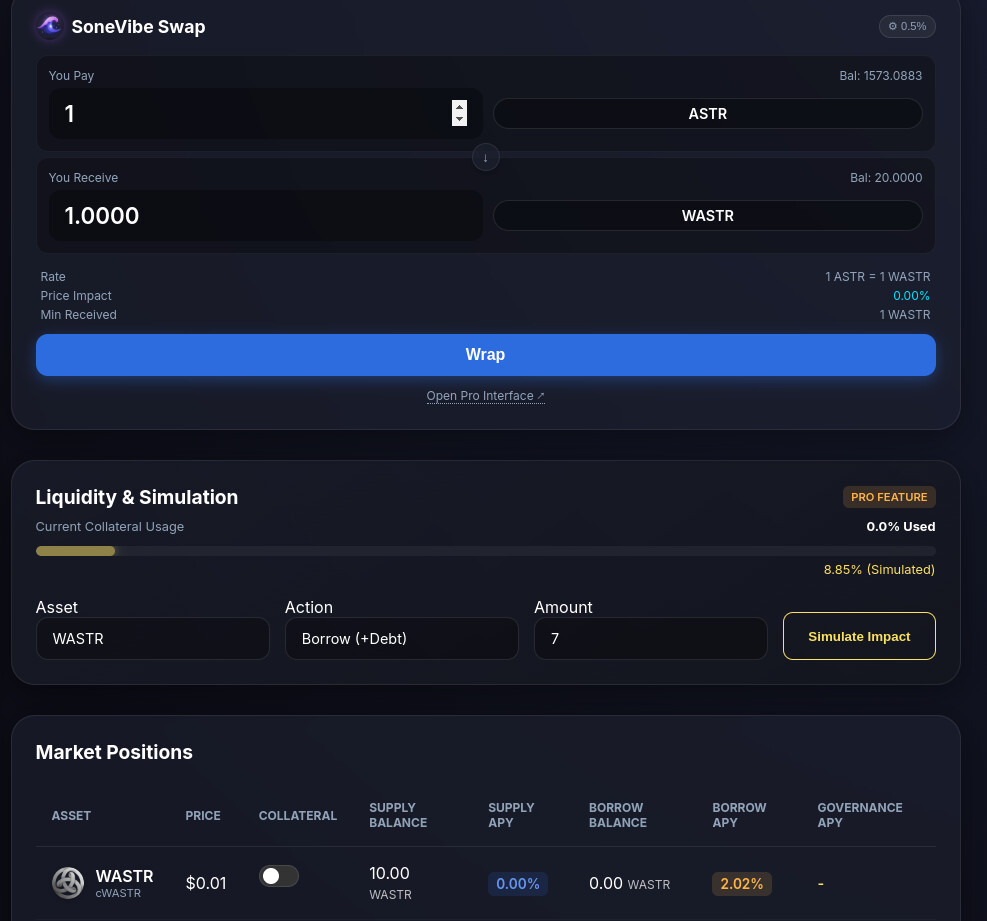
and aditionally we added the wrap/unwrap feature directly in the swap widget inside the lending platform to improve the ux:
Saying this we are making the roots to cross chain Polkadot-ASTAR-Soneium and Ethereum. we’re currently testing our stablecoin on testnet inspired on Hydradx+Aave+Venus+Maker Dao Dai . Astar is our core asset we’re commited to push ASTAR mass adoption like never before, we build for ASTAR. The Golden Age of Astar has Begun!
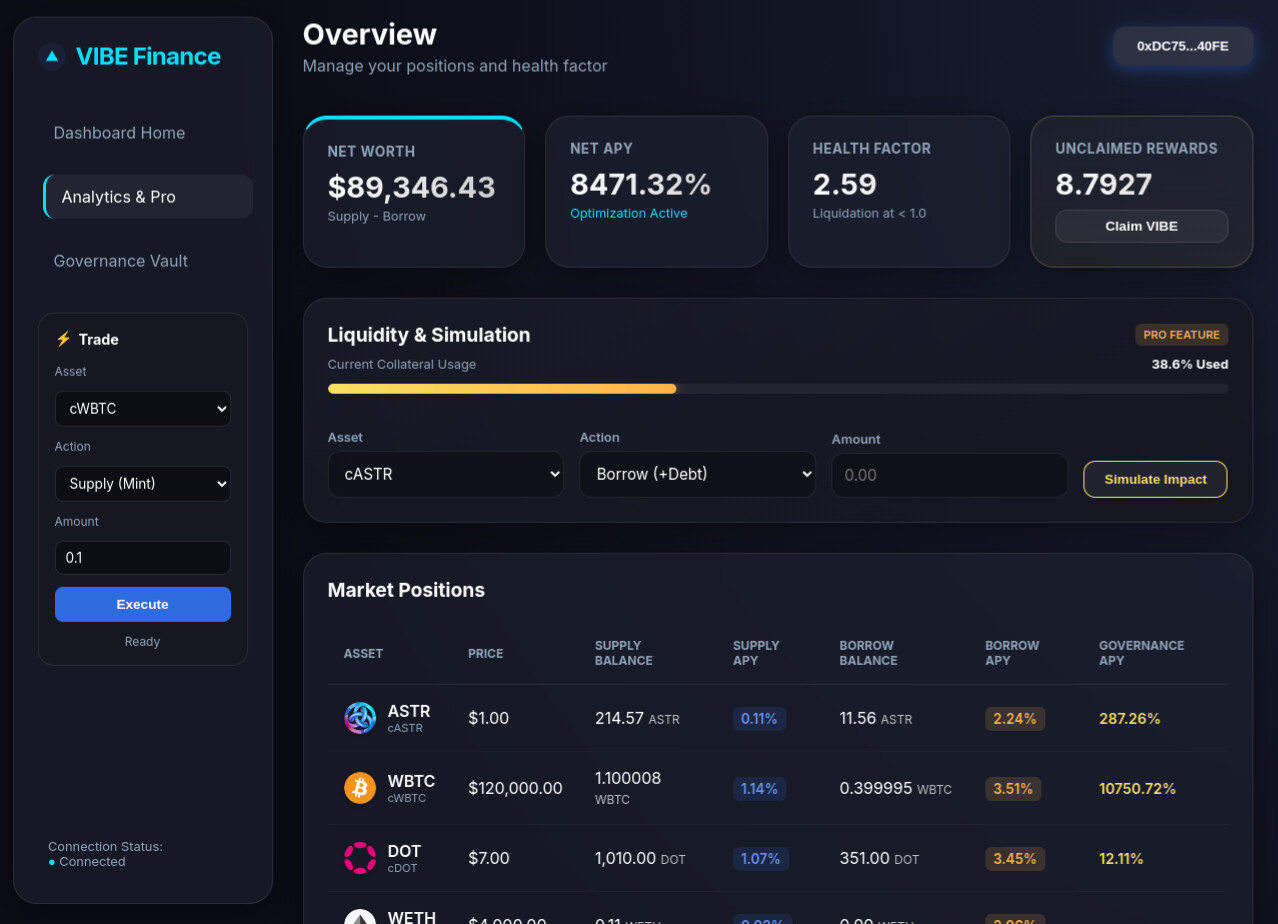
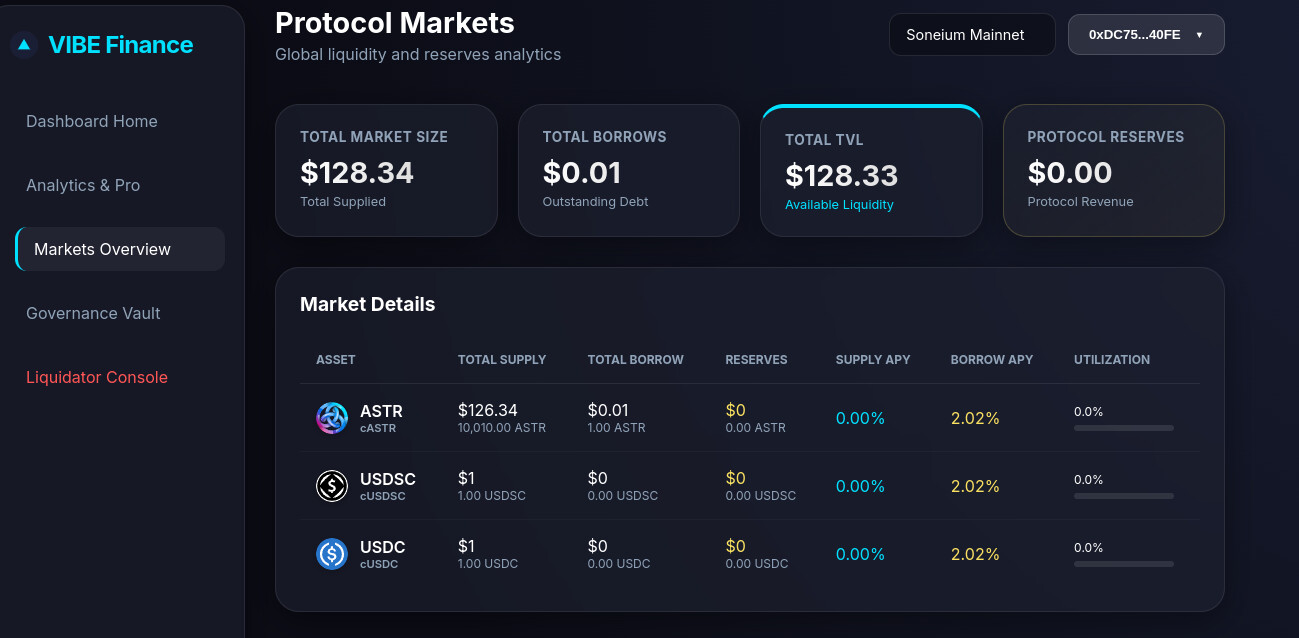

 and we have designated a % of our Governance token to reward Specially ASTR and USDSC Borrowers and suppliers.
 here rigth now! Astar is our Home!
 Update: Speaking of protocol design, I am happy to announce that VIBE Protocol is now LIVE on Astar EVM Mainnet as of today (Dec 9, 2025). We have deployed our enhanced

 "
" , we were trying to open one Astar Swap I don’t remember the name and the page doesn’t loaded properly so we said: hey, it’s better to have our own Swap and we wouldn’t have to wait for other swaps to load the page to wrap the astr, so I said let’s build it . We’re doing final tests on minato testnet, yesterday I was almost about to upload the dapp live but we have some frontend minimal details still to correct. We’re building 24/7 on Astar and minato on the back-end .
 your feedback are very welcome


 right. We will include the data on a new market page dedicated to SoneVibe swap (TVL , Trading Volume…etc).